A chronicle · the Attersee, since 1780
The house
From the house chronicle: one ledger (1780–1911), three school notebooks (1912–today). The ledger is in four different hands. The notebooks have been in one hand since 1979, and that hand is still writing. Transcribed by L., who was told to leave the spelling alone.
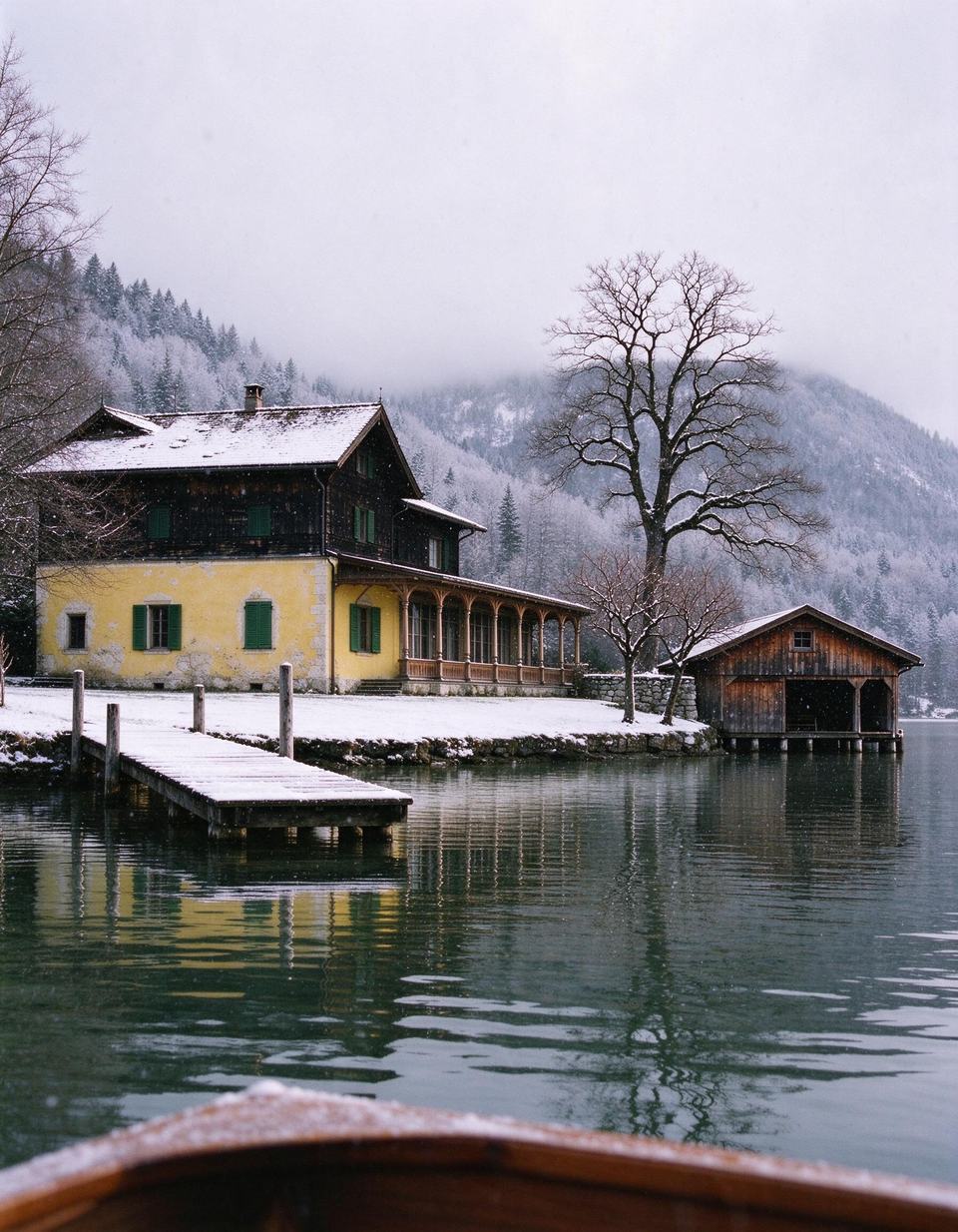
1780. A Falkenau from Vienna buys a strip of shore from a farmstead below the woods and builds a summer house on it. The ledger calls it das Sommerhaus and never anything grander. What it looked like, we know from the inventory and from how people built here then: a ground floor of quarry stone, lime-washed, with the kitchen and a vaulted cellar; an upper storey of spruce logs in the old block construction, boarded over against the weather; a shallow roof of shingles laid loose in rows and held down with stones, the way roofs were laid in this region until the nineteenth century. Small windows, a green tiled stove in the Stube, a lake outside the door. The land belonged, as all this shore did, to the lordship of Kammer; the castle on its island had been given its baroque face in 1710, and its court still sat in judgement over the Attergau. Our house sat under that jurisdiction for sixty-eight years and, as far as the ledger admits, never came before it.
1800–1848. The ledger is thin for half a century: fishing rights renewed, a Plätte bought (the flat wooden boat of the Salzkammergut, rowed standing, by one person, the way it still is), apples, a bad winter, a good one. The lake it faces is the largest lake lying wholly inside Austria: 46 square kilometres, nineteen kilometres long, 169 metres deep at the deepest sounding, 469 metres above a sea nobody in the ledger had seen. Its water comes mostly from the Mondsee by the Seeache and leaves by the Ager toward the Traun and the Danube; in winter you can see twenty metres down into it. In the afternoon, in fair weather, the Rosenwind comes up the lake from the north as the mountains warm, a steady breeze you can set a watch by. The chronicle records the Rosenwind more often than it records money, which tells you what the house was for.
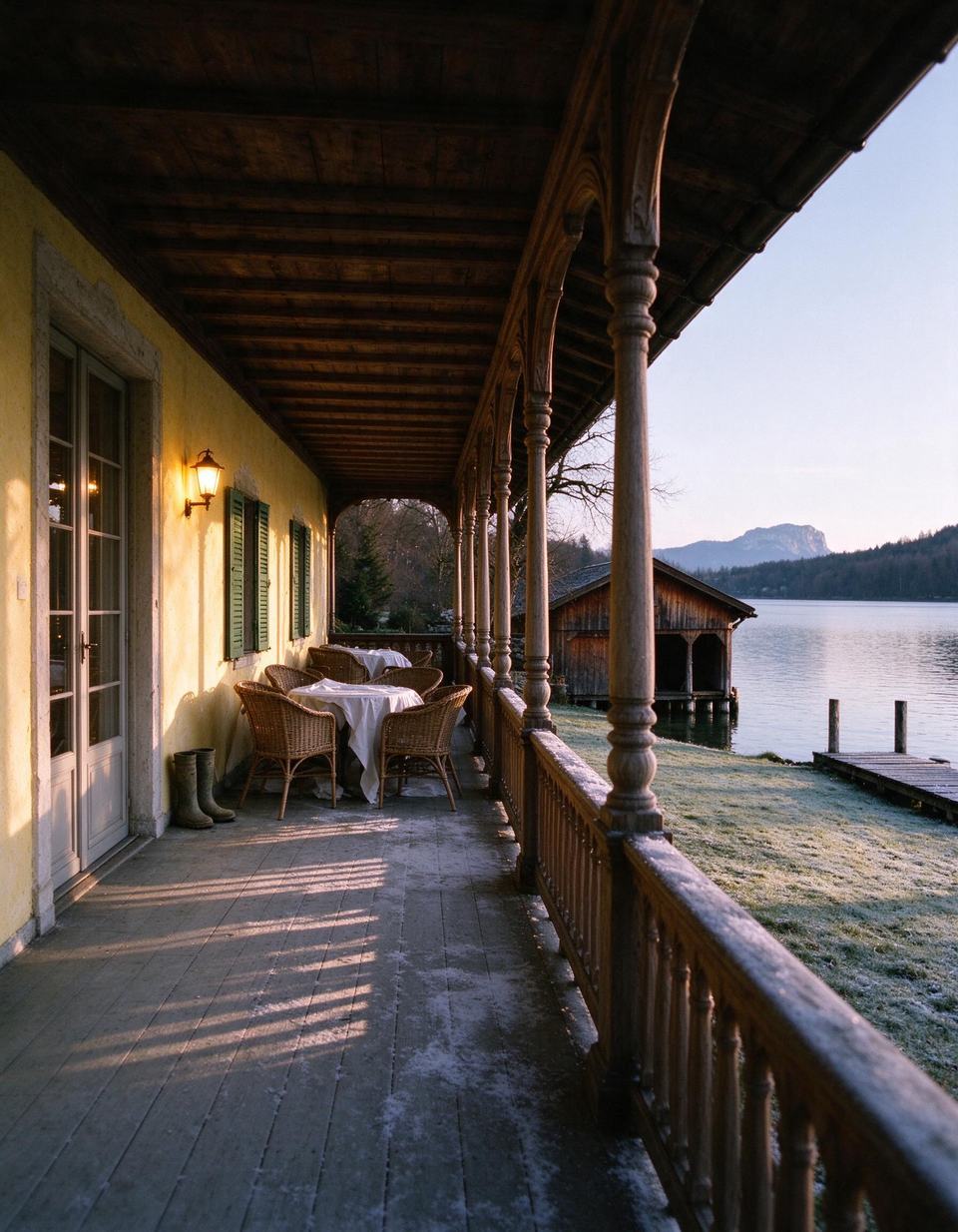
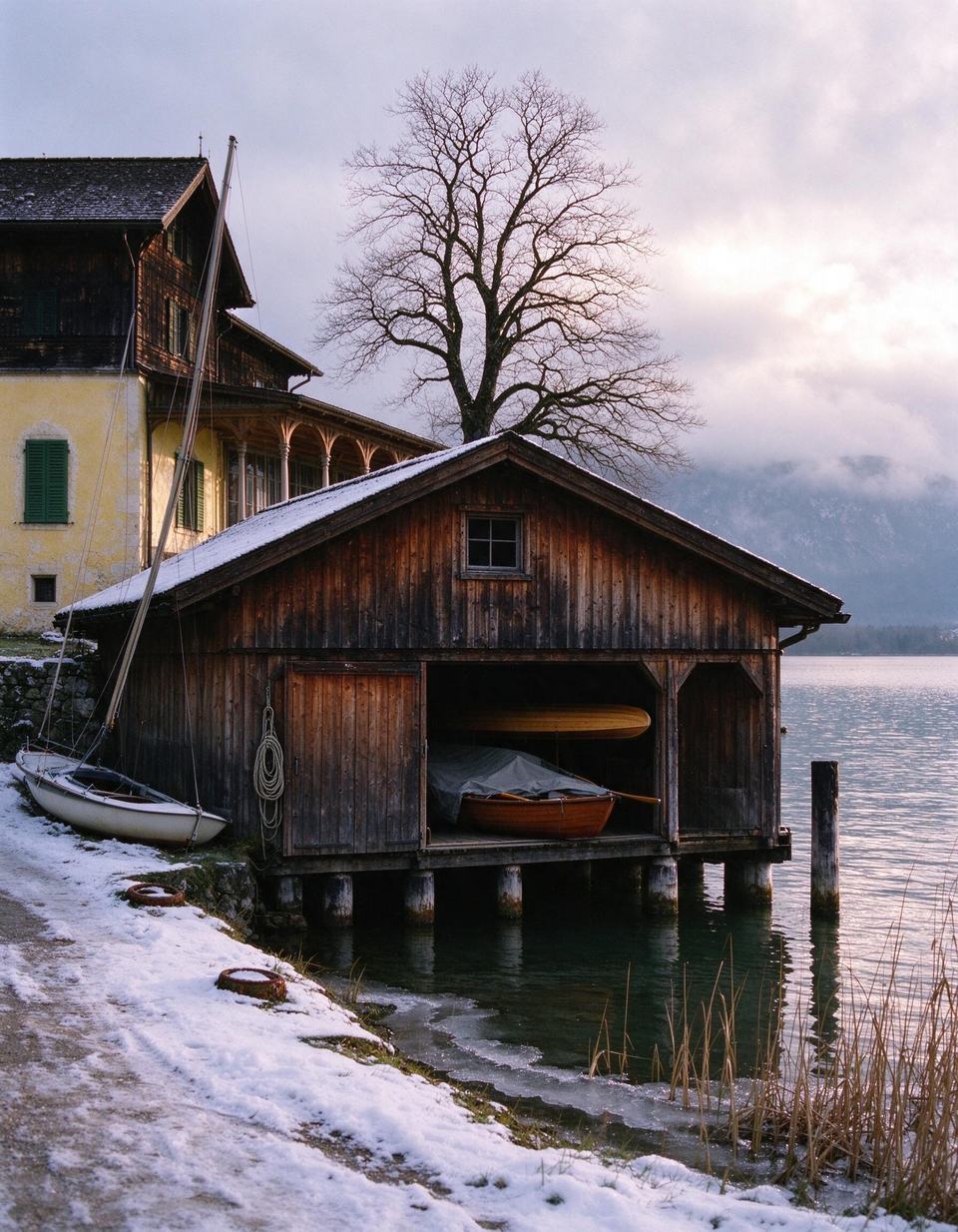
1850s. The boathouse. The ledger has the carpenter’s bill and nothing else, but the building is still there: timber on piles over the water, a slip for the boat, a loft above it that has been a bedroom for every teenager in the family since. In the same decade the house grows a long veranda facing the water, and behind it a wide room the family has called der Saal (the ballroom) for 170 years, though it has held perhaps a dozen balls and ten thousand card games. This is the decade the Salzkammergut became the summer address of the monarchy: the young Emperor Franz Joseph became engaged to Elisabeth of Bavaria at Bad Ischl in August 1853, and the villa his mother gave the couple became the imperial summer residence for the next sixty years. The Attersee, a day’s travel from Vienna, filled up with people who had summers to spend. The family, who had been spending summers here for seventy years already, found this both gratifying and a little vulgar. The chronicle uses the word Sommerfrischler for the first time in 1858, with a tone.
1869–1882. The lake gets engines. In February 1869 the screw steamer Ida, built at the Mayer yard in Linz for the count at Kammer, is the first steamship on the Attersee; the paddle steamers Attersee and Kammer follow in 1870 and 1872. The ledger records the first time the paddle steamer passed the house (“the children on the jetty, the dog in the water”). In 1882 the railway reaches Kammer-Schörfling at the north end of the lake, and from then on the summer begins the same way for forty years: the train to Kammer, the luggage onto the steamer or into the Plätte, and the house coming slowly closer across the water. Several of the villas you can still see from the lake date from these years; ours is older than all of them and smaller than most, and the family has always managed to say both things in one sentence.
1893–1916. The good years, and the famous neighbours we never had. Gustav Mahler built himself a one-room composing hut on the shore at Steinbach, on the far side of the lake, and finished his Second Symphony and wrote his Third there between 1893 and 1896. Gustav Klimt spent his summers on the Attersee from 1900 to 1916: at the brewery inn at Litzlberg until 1907, then at the Villa Oleander at Kammer, then at a forester’s house at Weissenbach, painting the lake water in square frames and Schloss Kammer seven times over. In 1913 the first electric boats, the Attergau and the Baron Handel, began to run alongside the steamers. The chronicle does not mention any of this. It lists eleven guests for August 1908, a piano tuner from Vöcklabruck, a new roof on the boathouse and a quarrel about a hat. There is no record of Klimt at the house and the family never claimed one, which in this region counts as a kind of distinction.
1919–1929. On 3 April 1919 the young republic abolished the nobility, and with it the right to the little word von. The family lost two letters and kept the house, which it considered the better end of the bargain, and took a flat in the Wieden district of Vienna in the 1920s so the children could go to school in the city and the lake could stay what it was. The von has been banned in this family since 1919; the joke about it has been in the family only slightly less long. In the winter of 1928/29 the Attersee froze over completely, which it almost never does, having too much water in it and too much wind on it; Maximilian, eighteen, walked from the jetty to the far shore and back and was not spoken to for two days. The lake froze again in 1939/40 and 1941/42. It has not done so since.
1944–1962. Leopold, called Poldi, is born in 1944, Charlotte in 1948, both in the house, in May, in the room over the veranda. The chronicle for these years is in Henriette’s hand: coal, ration cards, the boatman Hias coming back from the war with one lung, the first summer guests again in 1950, the Plätte repainted. For 1962 there is one line, and the line is not about the house. The lake takes and keeps. The family does not discuss it, and the chronicle, for once, agrees with the family.
1966–1976. Lotte is eighteen and goes to Menton with her aunt Resi for a summer, and comes back, and the chronicle says only “C. zurück, braun” (C. back, brown). In June 1971 she marries Georg Hartl, of the Linz paper-mill family, in the small chapel below the house; the chronicle records the weather (rain), the guests (forty) and, in a different ink, the condition agreed between the families: the children will carry the name Falkenau. Georg agreed to that. In 1976 Georg’s money does what the house had been waiting forty years for: a new roof, the boathouse rebuilt on new piles, the veranda releveled, the Saal painted. The last great summer party at the house is held that August, with a dance band from Linz and lanterns on the jetty. There is a photograph. Everyone in it looks as if the house would always be like that.
1979–1988. It would not. In 1979 Georg’s investment, a hotel with its own lift up the mountain, fails, and most of the Hartl money fails with it. The cook and the gardener are let go; Hias, who had been the boatman since before Lotte was born, stays on without wages and tells nobody. Maximilian dies in November of the same year. From 1980 the house does what the villas around it had done for a century and what it had always slightly looked down on: it lets rooms to summer guests. Lotte sells the Vienna car, learns the accounts, learns the roof. The chronicle changes hands in 1979 and has not changed hands since. In May 1988 Georg dies in the boathouse, of his heart, on a Sunday morning, with the boat half out of the water. Lotte is forty. Ferdinand is fifteen.
1995–2008. The bank’s letters, which had been arriving since 1992, stop in the autumn of 1995. The chronicle records the fact and not the reason, and Lotte, who keeps the chronicle, says it is accurate. Henriette dies that same autumn; Ferdinand marries Shirin Nouri, a pharmacist from Shiraz, in December, and the kitchen learns saffron. Konstantin is born in 1996, Leyla in 1999. Hias dies in 2004, and so does Resi, and the summers become the grandchildren’s. In 2008, the year the banks went down everywhere, the family tries to sell the house for the first time. In October men in suits walk through the Saal with a laser measure; the buyer withdraws on 19 December, because his own bank has stopped lending. Konstantin, twelve, watches from the stairs and remembers all of it. In 2011 UNESCO put three prehistoric pile-dwelling sites in the Attersee on its World Heritage list, at Litzlberg and Abtsdorf; the oldest houses on this lake are six thousand years old and under water, and the chronicle for 2011 notes this with what can only be called satisfaction.
What the house is like today
The roof leaks into the Saal. It has done so since 2022, at the east end, where the 1976 roof meets the 1850s wing, and there is a zinc bath under it that Lotte empties herself. The parquet has lifted there in a shape like a map of somewhere. Konstantin has a spreadsheet about this roof. Lotte has a bucket. Both are accurate.
The boathouse stands on its 1976 piles and smells of tar, wet rope and the lake. The Plätte is in it, and a rowing boat, and a sailing dinghy nobody has rigged since 2019. The loft above still has a bed in it. On the step, in pencil, in the boatman’s hand, a water-mark and a date: Aug. 02. Nobody has painted over it. Nobody in the family goes into the boathouse on Sunday mornings, and nobody has ever said why, and everyone knows.
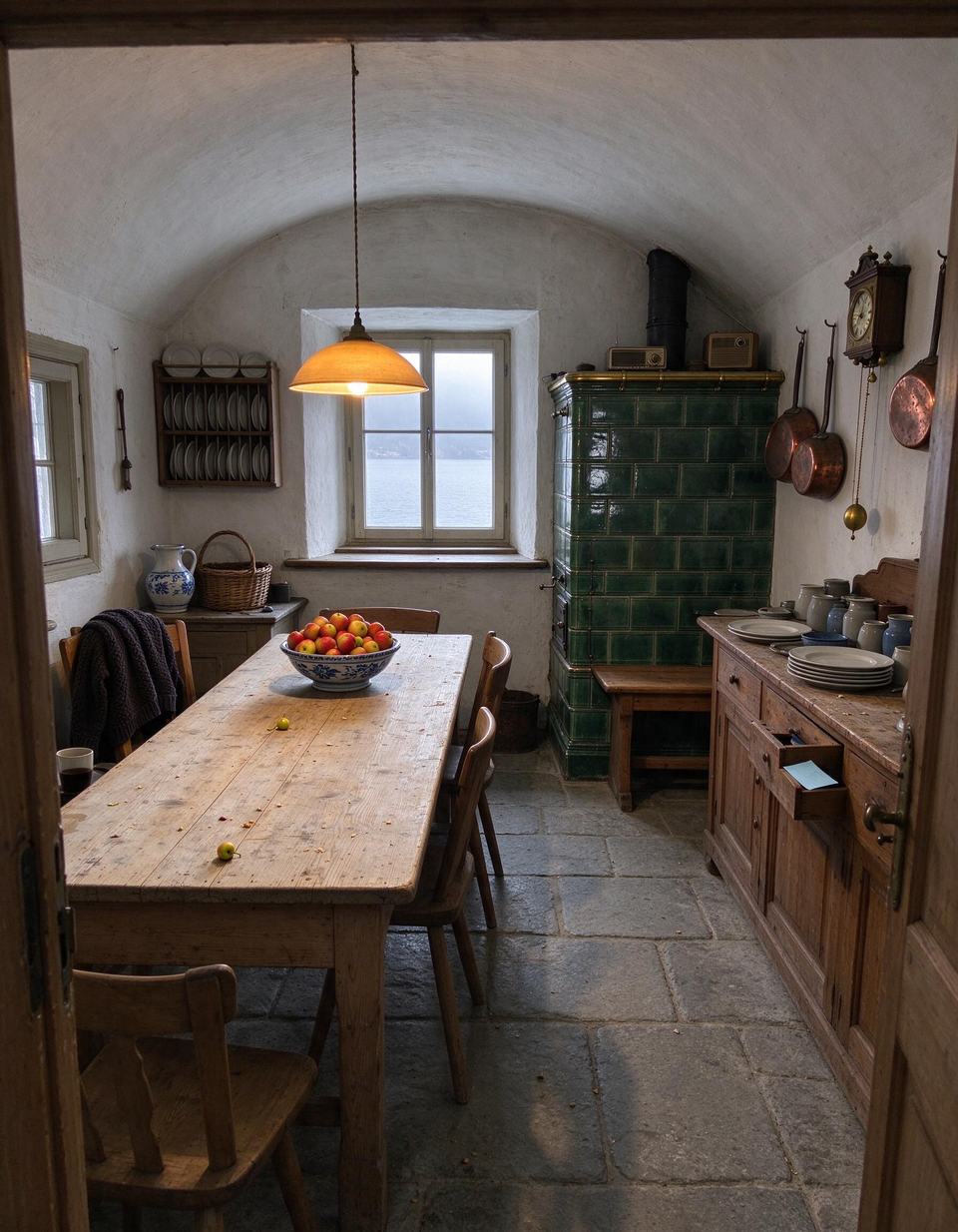
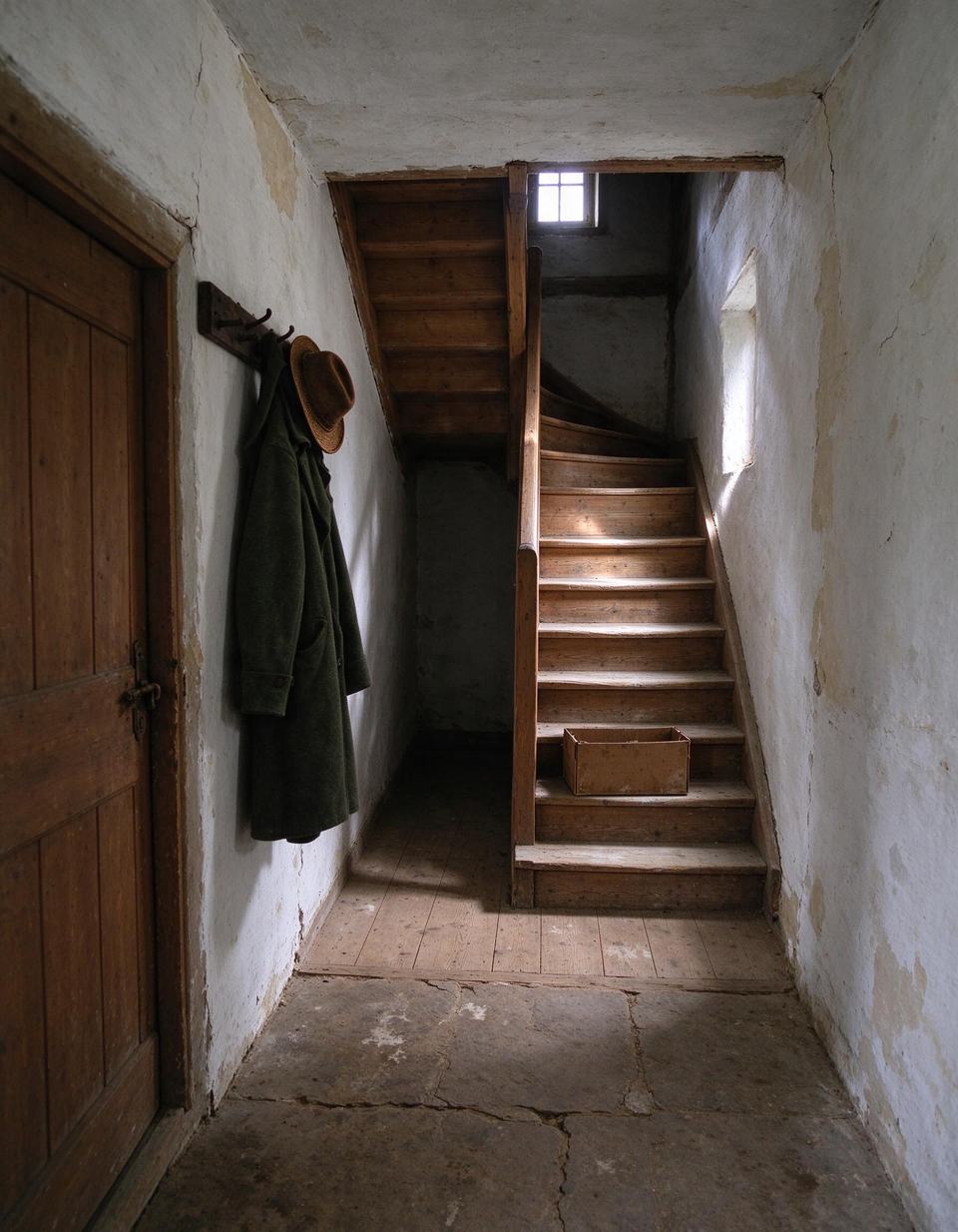
Lotte’s kitchen is the ground floor of 1780: the vault, the stone floor that is cold in August, the green stove that was converted to electricity in 1976 and still gets called der Ofen. There is a long table, apples in a bowl from October to March, a radio tuned to Ö1, a drawer of letters with Spanish stamps, all of them, in order. The recipes have their own page, Lotte’s kitchen. The attic stairs are at the end of the corridor behind the kitchen. The attic is not on this page.
In November 2026 a blue envelope went to Barcelona with one line in it: Come in December. There is something to discuss.
The Falkenau family, its house and everything that happened in it are fiction. The lake, the ships, the railway, the painters, the law of 1919 and every date that is not a Falkenau’s are real, and checked against the sources below.
Sources
- Attersee: size, depth, inflow and outflow, visibility, the Rosenwind, the complete freezes of 1928/29, 1939/40 and 1941/42, Sommerfrische and Klimt. de.wikipedia.org/wiki/Attersee; en.wikipedia.org/wiki/Attersee_(lake)
- Shipping on the Attersee: the Ida (February 1869), the Attersee (1870) and Kammer (1872), the electric boats Attergau and Baron Handel (1913), Stern & Hafferl. de.wikipedia.org/wiki/Attersee-Schifffahrt; salzkammergut.at, Attersee shipping company history
- Railway Vöcklabruck–Kammer-Schörfling, built 1882 (Land Oberösterreich chronology; year only, no day given). land-oberoesterreich.gv.at/13921.htm
- Schloss Kammer: first mentioned 1249, baroque conversion 1710 under Michael Prunner, seat of the Landgericht until 1848, 674 subjects in 1750. salzkammergut.at, Seeschloss Kammer
- Building traditions of the region: block construction in spruce, boarded over; shallow purlin roofs with loose-laid shingles (Legschindeln) weighted with stones, in use until the nineteenth century. Ländliche Baugeschichte Salzburgs (PDF); F. Mandl, hut architecture in Altaussee (PDF); the Eggerhaus museum at Altmünster, an 18th/19th-century farmhouse of the region. salzkammergut.at, Eggerhaus
- The Plätte, the flat wooden boat of the Salzkammergut, rowed by one person. salzkammergut.at, “The boat to the lake”; austriadirect.com, Plätten rides
- Sommerfrische: Bad Ischl, the engagement of August 1853, the Kaiservilla as imperial summer residence; the Attersee as a summer address from the mid-nineteenth century, the villas of the 1870s, Villa Paulick and its old boathouse. habsburger.net, Bad Ischl; en.wikipedia.org/wiki/Kaiservilla; salzkammergut.at magazine, “Zeitensprung”; oberoesterreich.at, Sommerfrische
- Gustav Klimt on the Attersee, 1900–1916: Litzlberg brewery inn (to 1907), Villa Oleander at Kammer (from 1908), forester’s house at Weissenbach (1914–16), Schloss Kammer painted seven times. klimt-database.com, Attersee; Klimt Foundation, Summer Sojourns on the Attersee
- Gustav Mahler’s composing hut at Steinbach, 1893–1896, Second and Third Symphony. en.wikipedia.org, Composing hut of Gustav Mahler (Attersee); mahler-steinbach.at
- Adelsaufhebungsgesetz of 3 April 1919 (StGBl. 211/1919), § 1: the right to the designation von revoked. ris.bka.gv.at; en.wikipedia.org/wiki/Austrian_nobility
- Prehistoric pile dwellings in the Attersee, UNESCO World Heritage 2011: Litzlberg Süd, Abtsdorf I and III. pfahlbauten.at factsheet (PDF); attersee-attergau.salzkammergut.at
A sketch
The plan
What is where, as far as anyone in the family agrees. The chronicle has no drawing of the house; this one was made at the kitchen table, with the ledger open and Lotte correcting from the stove.
From the kitchen at the lake
Lotte's kitchen
Reinanke from the lake, Tafelspitz, Kaiserschmarrn, the apricot dumplings from the two trees by the wall, and the rest of what she agreed to write down. In her words, with real quantities.
To the kitchen